
In 1946, Paramahansa Yogananda, one of modern India's greatest yogis, revealed in his classic "Autobiography of a Yogi," the existence of a Christ-like saint, an immortal yogi, Mahavatar Babaji. Yogananda related how Babaji had for centuries lived in the Himalayas guiding many spiritual teachers at a distance, usually without their even knowing it. Babaji was a great siddha, one who had overcome ordinary human limitations, and who worked silently, behind the scenes for the spiritual evolution of all humanity. Paramahansa Yogananda also revealed that it was Babaji who taught a powerful series of yogic techniques, know as "Kriya Yoga," to Lahiri Mahasaya, around 1861, and who subsequently initiated many others, including Yogananda`s own Christ-like guru, Sri Yukteswar, some thirty years later. Yogananda spent 10 years with his guru before Babaji himself appeared to him, and directed him to bring the sacred science of Kriya to the West. Yogananda fulfilled this sacred mission from 1920 to 1952, when he left his body and attained the yogic state of mahasamadhi. As a final tribute to the efficacy of Kriya Yoga and the blessings of his lineage, the body of Yogananda did not deteriorate during the 21 days it lay exposed, before being interred in a crypt in Los Angeles. March 7, 2002 marked the 50th anniversary of Yogananda's remarkable passing. When his remains were transferred to a permanent "samadhi" shrine in March 2002, millions around the world remembered with gratitude what Yogananda's legacy has given to them.
KRIYA BABAJI REVEALS HIMSELF
In South India, Babaji had been preparing, since 1942, two other souls for the task of disseminating his Kriya Yoga: S.A.A. Ramaiah, a young graduate student in geology at the University of Madras and V.T. Neelakantan, a famous journalist, and close student of Annie Besant, President of the Theosophical Society and mentor of Krishnamurti. Babaji appeared to each of them independently and then brought them together in order to work for his Mission. In 1952 and 1953 Babaji dictated three books to V.T.Neelakantan: "The Voice of Babaji and Mysticism Unlocked," "Babaji's Masterkey to All Ills," and "Babaji's Death of Death." Babaji revealed to them his origins, his tradition, and his Kriya Yoga. They founded on October 17, 1952, at the request of Babaji, a new organization, "Kriya Babaji Sangah," dedicated to the teaching of Babaji's Kriya Yoga. The books created a sensation at the time of their publication and distribution throughout India. The SRF (Self Realization Fellowship) attempted to have them and the Kriya Babaji Sangah suppressed, and it took the intervention of the then Prime Minister of India, Pandit Nehru, who was a friend of V.T. Neelakantan, to end their efforts. In 2003, Babaji's Kriya Yoga Order of Acharyas reprinted these three books in one volume called "The Voice of Babaji."
It is in the "Masterkey of All Ills," that Babaji reveals his answer to the question "Who Am I". In essence, this reveals, that when we know ultimately who we are, we will know who Babaji is. That is, Babaji does not identify with a limited human personality, or series of life events, or even his divinely transformed body. However, in writings he also revealed for the first time a number of precious details about his life story, in order to outline for us a path to Self-realization, which anyone may aspire to. These details have been subsequently documented in the book "Babaji and the 18 Siddha Kriya Yoga Tradition."
Babaji was given the name "Nagaraj," which means "serpent king," referring to "kundalini," our great divine potential power and consciousness. He was born on the 30th day of November 203 A.D., in a small coastal village now known as Parangipettai, in Tamil Nadu, India, near where the Cauvery River flows into the Indian Ocean. His birth coincided with the ascendancy (Nakshatra) of the star of Rohini, under which Krishna was also born. The birth took place during the celebration of Kartikai Deepam, the Festival of Lights, the night before the new moon during the Tamil month of Kartikai. His parents were Nambudri Brahmins who had immigrated there from the Malabar coast on the western side of south India. His father was the priest in the Shiva temple of this village, which is today a temple dedicated to Muruga, Shiva's son.
At the age of 5, Nagaraj was kidnapped by a trader and taken as a slave to what is today Calcutta. A rich merchant purchased him, only to give him his freedom. He joined a small band of wandering monks, and with them became learned in the sacred religious and philosophical literature of India. However, he was not satisfied. Hearing of the existence of a great siddha, or perfected master, named Agastyar, in the south, he made a pilgrimage to the sacred temple of Katirgama, near the southern most tip of Ceylon, the large island just south of peninsular India. There he met a disciple of Agastyar, whose name was Boganathar. He studied "dhyana," or meditation, intensively and "Siddhantham," the philosophy of the Siddhas, with Boganathar for four years. He experienced "sarvihelpa samadhi," or cognitive absorption, and had the vision of Lord Muruga, the deity of the Katirgama temple.
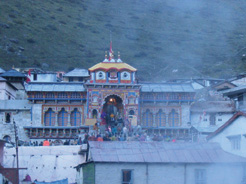
At the age of 15, Boganathar sent him to his own guru, the legendary Agastyar, who was known to be living near to Courtrallam, in Tamil Nadu. After performing intensive yogic practices at Courtrallam for 48 days, Agastyar revealed himself, and initiated him into Kriya Kundalini Pranayama, a powerful breathing technique. He directed the boy Nagaraj to go to Badrinath, high in the Himalayas, and to practice all that he had learned, intensively, to become a "siddha." Over the next 18 months, Nagaraj lived alone in a cave practicing the yogic techniques which Boganathar and Agastyar has taught him. In so doing, he surrendered his ego, all the way down to the level of the cells in his body, to the Divine, which descended into him. He became a siddha, one who has surrendered to the power and consciousness of the Divine! His body was no longer subject to the ravages of disease and death. Transformed, as a Mah or great siddha, he dedicated himself to the uplift-ment of suffering humanity.
BABAJI'S LONGEVITY
Since that time, over the centuries, Mahavatar Babaji has continued to guide and inspire some of history`s greatest saints and many spiritual teachers, in the fulfillment of their mission. These include Adi Shankaracharya, the great 9th century A.D. reformer of Hinduism, and Kabir, the 15th century saint beloved by both the Hindus and Muslims. Both are said to have been personally initiated by Babaji, and refer to him in their writings. He has maintained the remarkable appearance of a youth of about 16 years of age. During the 19th century Madame Blavatsky, the founder of the Theosophical Society, identified him as the Matreiya, the living Buddha, or World Teacher for the coming era, described in C.W. Leadbetter's "Masters and the Path."
MAHAVATAR BABAJI'S REVIVAL OF KRIYA YOGA
Babaji revives Kriya Yoga, which Siddha Patanjali refers to in his famous "Yoga-Sutras." Patanjali wrote his classic text of yoga about the 3rd century A.D. In it he defines Kriya Yoga in II.1 as "constant practice (particularly by the cultivation of detachment), self-study and devotion to the Lord." However, along with what Patanjali described as Kriya Yoga, Babaji added the teachings of the tantra, which includes the cultivation of "kundalini," the great potential power and consciousness, through the use of breathing, mantras and devotional practices. His modern synthesis of "Kriya Yoga," includes a rich variety of techniques. It was in 1861 that Babaji initiated Lahiri Mahasaya into his powerful Kriya Yoga system.
OTHER TECHNIQUES OF KRIYA YOGA ARE REVEALED BY BABAJI
During a six month period in 1954, at his ashram near Badrinath, in the Garwhal Himalayas, Babaji initiated a great devotee, S.A.A. Ramaiah into a complete system of 144 Kriyas, or practical techniques, involving postures, breathing, meditation, mantras and devotional techniques. The latter blossomed as a yogi, and began a mission to bring this system, referred to as "Babaji`s Kriya Yoga" to thousands of aspirants ALL AROUND THE WORLD.
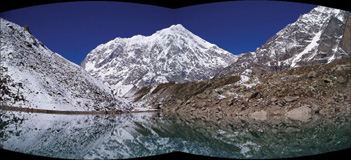
Fortunately, Babaji comes out from behind the veils of anonymity which he finds so useful for his work. Babaji has appeared to Swami Satyaswarananda in the Kumaon Hills of the Himalayas, in the early 1970`s and given him the assignment of translating and publishing the writings of Lahiri Mahasaya. This he has done in a series, the "Sanskrit Classics," from his home in San Diego, California. Babaji gave his "darshan" on the vital plane to the author, M. Govindan, in October 1999, on two occasions. This occurred 30 kilometers north of Badrinath, at an altitude of nearly 5,000 meters, at the source of the Alakananta River. During these visitations, Babaji appeared as a radiant youth, with copper colored hair, clad in a simple white "dhoti" or waist cloth, and allowed Govindan to touch his feet.
BABAJI'S ATTAINMENT
One cannot really know who Babaji is, or even begin to conceive of his grandeur, without appreciating the culture of the Siddhas from which he has emerged. Rather than seeking an other worldly escape in some heaven, after realizing the presence of the Divine within, the Siddhas sought to surrender their entire being to It, and to allow It to manifest at all levels. They sought a complete transformation of our human nature.
"Thirumandiram," by the Siddha Thirumoolar, written in the 2nd to 4th century A.D. in 3,000 gemlike verses, reveals the breath and depth of the Siddhas attainments. Our research has revealed that Thirumoolar was a brother disciple of Boganathar, Babaji's guru, and of Patanjali, one of the most well known sources of Yoga. While most of the Siddha's literature has not been translated outside of their native language of Tamil and Sanskrit, there exist a few good studies, most notably Dr. Kamil Zvelibil's "Poets of the Powers," and Professor David Gordon White's "The Alchemical Body." Both of these academic works demonstrate at length the remarkable attainments of the Siddhas, and reveal that Babaji was not some unique extraterrestrial. He manifests what Sri Aurobindo referred to and aspired to for all humanity: "the supramental transformation" of our human nature, perhaps the next step in our evolutionary process. As such, he is not our savior. Nor is he the founder of some religion. He does not seek our adulation or even our recognition. Like all of the Siddhas, he has surrendered completely to the Supreme Being, the Supreme Abstraction, and as a divine instrument, brings down into this murky world the clear light of consciousness, unconditional joy and supreme peace. May everyone achieve this greatest human potential.
FREE JOURNAL
To Receive a FREE copy
of our current
Kriya Yoga Journal
by email
NEWS
New Amazon “Kindle” edition of The Voice of Babaji:
Order it here

Initiation at the Quebec
1st Initiation
September 19-21, 2025
May 15-17, 2026
May 22-24, 2026
August 28-30, 2026
September 18-20, 2026
With M. G. Satchidananda
Quebec: click here for details
Warwick, RI: click here for details
Free Yoga classes at the Kriya Yoga Ashram in St. Etienne de Bolton
Temporarily suspended...
Click here for details
2nd Initiation
October 3-5, 2025
June 19-21, 2026
October 2-4, 2026
With M. G. Satchidananda
Click here for details
3rd Initiation
July 17-26, 2026
With M. G. Satchidananda
Click here for details
Kriya Hatha Teacher Training
August 6-21, 2026
With M. G. Satchidananda and Durga Ahlund
Click here for details

NEW: Receive our Inspirational Babaji message cards!
via WhatsApp or Instagram
Click here for details

* Testimonial *
student testimonials and insights
Click here for 1st initiation
Click here for 2nd initiation
Not receiving our emails?
LINKS
Visit Thirumandiram Site www.thirumandiram.net
Visit Jesus and Yoga Site www.jesusandyoga.net
Other good links
